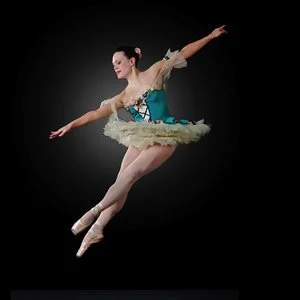
Why I Wait Until Age 7 to Teach Arabesque
Here's an opinion that might be a little unpopular among preschool ballet teachers: I don't think we should be formally teaching arabesque to children under the age of seven.
Now, before you picture me telling a four-year-old she can't pretend to be an airplane with one leg stretched behind her, let me explain! I'm not suggesting that younger children should never lift a leg behind their bodies or explore balancing in different positions. What I'm talking about is teaching arabesque as a formal ballet position, with expectations for correct placement, turnout, alignment, and control.
Arabesque is such a beautiful and recognizable ballet position that I can certainly understand why teachers want to introduce it early. And when we see photographs of little ballerinas standing in arabesque, they can be adorable! But just because a young child can imitate the shape of a movement doesn't necessarily mean she's developmentally ready to perform it with correct technique.
I believe there's quite a bit of value in waiting until students have developed a stronger foundation in balance, alignment, and body awareness before formally introducing arabesque. In my own teaching progression, I prefer to wait until around age seven, when students begin more structured ballet training.
Here's why.
Arabesque Requires More Than Lifting a Leg Behind the Body
When we look at an arabesque, it's easy to focus on the beautiful line of the working leg extending behind the dancer. But there's actually quite a lot happening throughout the body to maintain that position.
The supporting leg needs to be properly aligned, the pelvis needs to be controlled, and the dancer must be able to extend the working leg behind her without simply arching through her lower back. She also needs to coordinate the placement of her arms, head, and upper body while maintaining her balance.
And if we're teaching arabesque with turnout, there's another layer of technical difficulty to consider.
That's a lot for a beginning ballet student to think about, particularly a young child who's still learning where different parts of her body are and how to coordinate them.
One of the challenges of teaching arabesque is that the working leg is extending behind the dancer, where she can't easily see it. A young student may think she's lifting her leg directly behind her when she's actually turning her hips, arching her back, or allowing the working leg to drift out of alignment.
She may be able to imitate the general shape of an arabesque, but that doesn't necessarily mean she's using the muscles or maintaining the alignment we want to teach.
And I think that's an important distinction.
Young Children Are Still Developing Body Awareness
One of the reasons I prefer waiting to introduce formal arabesque is that young children's body awareness is still developing.
You may have heard the term proprioception. This is our sense of where different parts of our bodies are positioned, even when we aren't looking directly at them. It's what helps us recognize where our arms and legs are in space and make adjustments to our movements without having to watch every part of our bodies.
Proprioception is something we rely on constantly as dancers. Think about performing an exercise at the barre. We need to know where our working leg is positioned, whether our supporting leg is properly aligned, and how our pelvis and upper body are moving, often while concentrating on the music or another technical detail.
Young children already have proprioceptive abilities, of course. Otherwise, they wouldn't be able to walk, run, jump, or perform all the other movements they do every day. But the precision and consistency of their body awareness continue developing throughout childhood.
This is one reason you may notice such a difference between a five-year-old and an eight-year-old when teaching certain movements. An older child may be better able to recognize when her hips have shifted or her supporting leg has bent, while a younger student may need much more demonstration and guidance.
And when we're teaching a position like arabesque, where the working leg moves behind the body and out of the dancer's direct line of sight, that developing body awareness becomes particularly relevant.
It doesn't mean a child under seven is physically incapable of lifting her leg behind her. It means we should think carefully about the level of technical precision we're expecting from her.
Balance and Postural Control Are Still Developing, Too
Another reason arabesque can be challenging for young dancers is the amount of balance and postural control it requires.
Balancing on one leg is already a skill that develops considerably during early childhood. Now imagine asking a child to maintain her balance while extending the other leg behind her and coordinating the placement of her upper body and arms.
As the working leg moves backward, the dancer needs to make adjustments throughout her body to maintain her position. She must control the supporting leg and pelvis while coordinating the muscles involved in extending the working leg.
For a student who is still developing basic balance and coordination, maintaining all of those elements at once can be quite challenging.
And there's another thing I think we need to consider. When young children are asked to lift a leg higher than they can comfortably control, they may compensate by arching through the lower back or changing the position of the pelvis.
We certainly don't want to encourage those habits simply to create a higher arabesque.
I would much rather see a student develop proper alignment and control with simpler movements before introducing a position that requires her to coordinate so many technical elements at once.
Why I Prefer to Wait Until Around Age Seven
So why seven?
For me, age seven is a practical point in a child's ballet training when I generally begin introducing more formal technique. By this age, many children have developed greater balance, coordination, body awareness, and the ability to understand and apply more detailed technical corrections.
Of course, children don't all develop at the same rate. Some six-year-olds may have excellent body awareness and control, while some eight-year-olds may still need considerable work on their alignment and balance. Age alone doesn't tell us whether a child is ready for a particular movement.
But when designing a curriculum for groups of children, we need to think about what is developmentally appropriate for most students in a particular age range, not simply what the most advanced child in the class can accomplish.
And I think there are so many other valuable things we can teach children under seven that there's really no reason to rush into formal arabesque.
In my preschool and early elementary teaching progression, I would rather concentrate on the movement skills and technical concepts that will help students perform arabesque correctly when they're ready.
That way, when we do begin teaching it, we can spend more time developing good technique rather than trying to correct habits students may have developed from repeatedly practicing a position they weren't ready to control.
What Should We Teach Before Arabesque?
Quite a lot!
When teaching preschool and early elementary ballet, I like to concentrate on developing the foundational skills students will eventually need for more advanced technique.
Balance
Before expecting a student to balance in arabesque, I want her to become comfortable balancing in simpler positions.
For preschoolers, that might mean standing on one foot during an imaginative activity or practicing relevés with an appropriate amount of support. Older children might begin holding a balance in parallel passé or another simple position as they develop greater stability and control.
We can also use traveling activities that challenge balance without requiring students to maintain a formal ballet pose.
For example, children might pretend they're flamingos standing in a pond or explorers walking carefully along a narrow bridge. These activities give them opportunities to practice balance while enjoying imaginative movement.
Posture and Alignment
I also spend quite a bit of time introducing correct posture and alignment in the early levels.
For preschoolers, this doesn't need to be particularly complicated. We might pretend we're wearing beautiful crowns or necklaces and need to stand tall to show them off. As students grow older, we can begin introducing more specific corrections related to the placement of the pelvis, spine, and supporting leg.
I think it's especially important for students to become familiar with maintaining good alignment before we ask them to coordinate more complicated positions.
A student who struggles to maintain her posture while standing on two feet isn't necessarily ready to hold that same alignment while balancing on one leg with the other extended behind her.
Basic Ballet Technique
Of course, we'll also continue introducing foundational ballet technique.
Pliés, tendus, relevés, and simple positions of the feet and arms all give students opportunities to develop coordination, strength, and control. As children become more technically proficient, we can gradually introduce additional details about turnout, weight placement, and how the feet articulate through movement.
In particular, tendus provide a wonderful opportunity to introduce moving the working leg in different directions while maintaining the placement of the supporting leg and pelvis.
Even a simple tendu derrière allows students to begin exploring the action of extending the leg behind the body without immediately adding the demands of a lifted arabesque.
I would much rather spend time helping students understand these fundamental movements than rush them into a more advanced pose because it looks beautiful.
But What About Pretending to Be Airplanes or Birds?
This is where I want to make an important distinction between imaginative movement and formal ballet technique.
If I'm teaching a class of four-year-olds and we're pretending to be airplanes, I may very well have students stretch one leg behind them as they fly through the room. Or perhaps we're pretending to be birds balancing on branches, and children explore different positions with one leg lifted.
I don't have a problem with those activities when they're appropriate for the children and taught with reasonable expectations for balance and safety.
But I wouldn't call those movements technically correct arabesques or begin making detailed corrections about the placement of the working leg, turnout, and upper body.
Instead, I'm giving children opportunities to explore balance, direction, and different ways of moving their bodies. Those experiences can be valuable in their own right, even when they don't look like formal ballet steps.
There's a difference between allowing a child to explore a movement and expecting her to execute it according to the technical standards of classical ballet.
And I think recognizing that difference is an important part of teaching young children well.
Introducing Arabesque When Students Are Ready
When students are ready to begin learning arabesque, I prefer to introduce the position gradually rather than immediately asking them to lift their working legs high behind them.
We can begin by reviewing posture, placement, and the alignment of the supporting leg. I also like to revisit tendu derrière so students are familiar with extending the working leg behind the body while maintaining control of the pelvis.
From there, we can begin introducing a low arabesque with support at the barre.
At first, I would concentrate on the correct placement of the working leg and pelvis rather than the height of the arabesque. Can the student extend her leg behind her without twisting her hips or arching excessively through the lower back? Can she maintain control of the supporting leg? Can she hold the position briefly without losing her alignment?
Those are the things I'd be looking for before asking students to increase the height or complexity of the movement.
And just as with other beginning ballet exercises, I wouldn't introduce too many technical details at once. We can begin with a simple leg position, then gradually work on coordinating the arms, head, and upper body as students become more comfortable.
Some students will progress more quickly than others, and that's fine. The important thing is that we're building on movements they can already perform with reasonable control.
There's No Need to Rush Ballet Technique
I think one of the challenges of teaching young dancers is resisting the temptation to introduce more advanced steps before students are ready.
We want our classes to be interesting and challenging, and of course, we want parents to recognize that their children are learning real ballet. But more complicated movements don't necessarily mean better instruction.
Sometimes the best thing we can do for our students is spend more time developing the fundamentals.
A child who learns to maintain good posture, balance with control, articulate her feet properly, and understand the basics of alignment is developing skills she'll use throughout her ballet training.
And when she's ready to begin learning arabesque, those skills will help her understand and perform the position with greater control.
So while I know not every ballet teacher will agree with waiting until around age seven to formally introduce arabesque, it's the approach I prefer in my own teaching.
There's plenty for our youngest dancers to learn without rushing them into more advanced technique. We can give them a wonderful introduction to ballet through imaginative movement, simple steps, musicality, and activities that develop strength, coordination, and body awareness.
Then, as they grow and become ready for more formal instruction, we can begin building on that foundation.
Because in beginning ballet, I would much rather teach a movement correctly when a student is ready than spend years trying to correct habits that could have been avoided in the first place.